


Inspection & Testing
Initial Verification
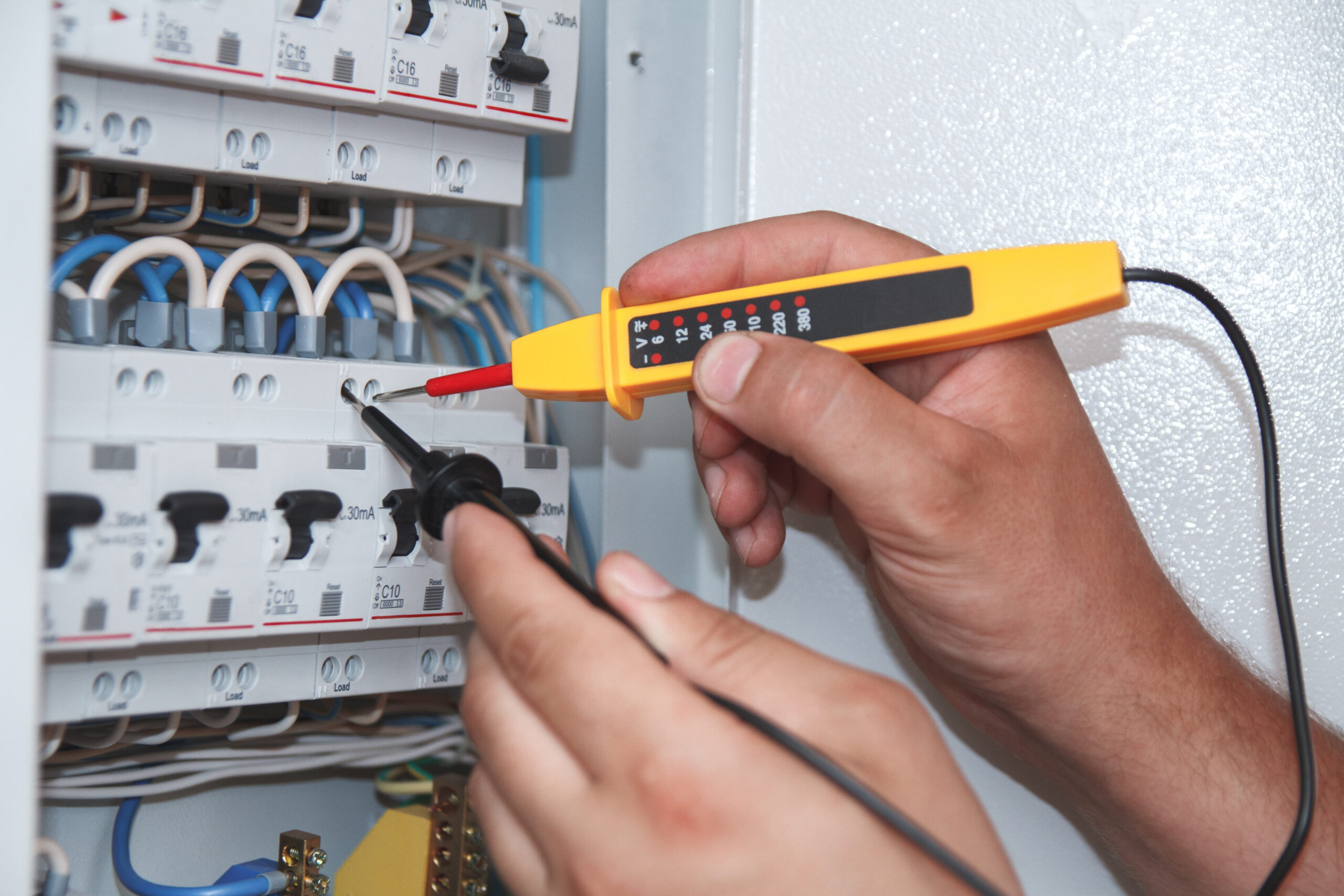
Walsh Electrical Services carry out an initial verification of all new electrical installation work constructed by us, whether in non-domestic or domestic premises. Upon completion of the work we will issue an Electrical Installation Certificate; Minor Electrical Installation Works Certificate; Completion Certificate for Electrical Installations with a Maximum Import Capacity <50kVA; Completion Certificate for an Electrical Installation with a Maximum Import Capacity ≥50kVA, or a Completion Certificate for Existing Installations (as appropriate). Other certification is also provided where required (e.g. for emergency lighting or fire alarm installations).
Certification provides you with proof that your installation has been designed, constructed, inspected, tested and verified in compliance with either the IET Wiring Regulations for work in the North, or the NSAI (formerly ETCI) National Wiring Rules for work in the South.
Periodic Inspection and Testing
(Safe Electric (RECI/ETCI) Periodic Inspection Report & NICEIC/ECA Electrical Installation Condition Report)
We also carry out high-end periodic inspection and testing of electrical installations in both non-domestic (including industrial and commercial) and domestic (dwelling) settings, complete with the issuance of an Electrical Installation Condition Report or Periodic Inspection Report for an Electrical Installation (as appropriate), or other reports as required. Furthermore, we can advise on any necessary remedial work to ensure the safety of any electrical installation for which you are responsible. This includes the inspection, testing and reporting required under the Private Tenancies Electrical Safety Standards Regulations in the north.
Whilst these are often erroneously referred to as “certificates”, it is important to note that they are, in fact, not certificates but rather reports on the existing electrical installation. Certificates pertain only to new electrical installation works, as these contain signed declarations certifying that the works conform fully to the relevant technical standard. Reports, on the other hand, are an assessment of the safety of the electrical installation, and do not make any claim of absolute compliance with these standards. Instead they note non-compliances or breaches of the Regulations/Rules which might undermine the safety or the installation, or its suitability to remain in service.
Safe Electric and the Health and Safety Authority (HSA) recommend that most types of electrical installations in the south of Ireland be inspected and tested at least once every five years. However, depending on the nature, location and use of the installation the inspection and testing may need to be more frequent. Regulation 89(b) of SI 299 of 2007, as amended by SI 732 of 2007 applies to the workplace and requires that employers ensure that existing electrical installations are inspected and tested by a competent person periodically. The competent person shall then compile a report (Periodic Inspection Report), and any defects found during the inspection and testing must be rectified promptly so as to prevent danger. This report is also known as an ETCI Periodic Inspection Report. We will hold any Test Record Sheets for the electrical installation for inspection & audit purposes by RECI/Safe Electric.
Whilst very often a P.I.R. showing that “no remedial work is required” is desired this is only possible where the installation is actually in a safe and compliant condition. Otherwise remedial works (including appropriate certification) will be necessary whilst conducting the inspection in order to issue a Periodic Inspection Report which does not recommend remedial work. Alternatively we can issue a P.I.R. containing observations leaving the client free to seek quotations for remedial works.
Should a quote for remedial works be required this is only possible following completion of the inspection and reporting initially quoted for. Otherwise we would not be in a position to know the extent or cost of either materials or labour required. As such a quote for periodic inspection and testing is always exclusive of any and all remedial work to the existing electrical installation.
We cannot reissue a modified Periodic Inspection Report following remedial works. (Such a course of action would require a new inspection and a new report at further cost.) However this should not be necessary as the Completion Certificate for any remedial works should be read in conjunction with the Periodic Inspection Report to prove that the necessary works have been completed.
OLEV/OZEV Electric Vehicle Homecharge Scheme (EVHS) & Workplace Charging Scheme (WCS)
Walsh Electrical Services are an Office for Low Emission Vehicles (OLEV) — also known as the Office for Zero Emission Vehicles (OZEV) — Authorised Installer for the UK Government's Electric Vehicle Homecharge Scheme (EVHS) and Workplace Charging Scheme (WCS).
We are authorised to install eligible equipment under these schemes from the following manufacturers:
You will also receive an NICEIC or ECA Electrical Installation Certificate for the works. PEN (protective earthed neutral) fault protection can be provided where necessary to mitigate against the hazards arising out of a broken PEN conductor.
EVHS & WCS Grant Amounts
EV Homecharge Scheme (EVHS)
Claim a 75% grant towards a charge point installation, capped at £350.
- A second chargepoint can be claimed if you can evidence keepership of two eligible EVs.
Workplace Charging Scheme (WCS)
Claim a 75% grant towards each charge point installation, capped at £350 per socket.
- Maximum of 40 units.
- Can be installed across multiple sites.
Grants are due to increase to a maximum of £500 per chargepoint from 1st April 2026.
The grant amount is offset against the cost of installation — we apply for the grant rebate on your behalf via OLEV. You will be invoiced for the cost of installation less the grant amount, and the grant is subsequently paid directly to us by OLEV.
As the customer, your duties include ensuring you meet the qualifying criteria, helping us complete the application by verifying the information provided is correct, and providing any documentation we require. You are also obliged to inform us if your circumstances change prior to installation, as this may affect your grant eligibility.
These are now known as the EV Chargepoint Grant and EV Infrastructure Grant, as well as WCS.
Changes to EVHS
From April 2022, the EVHS is no longer open to homeowners (including people with mortgages) who live in single‑unit properties such as bungalows and detached, semi‑detached or terraced housing.
Installations in single‑unit properties needed to be completed by 31 March 2022, with a claim submitted to the Driver and Vehicle Licensing Agency (DVLA) by 30 April 2022.
The scheme remains open to:
- Homeowners who live in flats
- People in rental accommodation (flats and single‑use properties)
This has been renamed the EV Chargepoint Grant.
Where We Install
We cover primarily Derry and Donegal — including Buncrana and other parts of Inishowen, along with Letterkenny and the rest of the county — and occasionally the wider North‑West of Ireland (*e.g. Sligo and Leitrim).
Our focus is on quality installations which are fully compliant with the relevant Rules/Regulations. This cannot be done cheaply. If you are looking for the cheapest possible installation, we are unable to cater for this, as it would require us to compromise standards. These are high‑current devices which operate for long durations, and electrical safety is our primary concern. Good quality installations are not inexpensive.